Personal Saving Rate - Why it's Pointless to Compare
August 2020 · 14 min read
Comparing your personal saving rate to someone else’s may leave you feeling happy or depressed. But saving rate is a number and there are so many ways of calculating it that comparing it to someone else is like comparing apples to oranges. I will show you how using different calculations can drastically change the final number.
At the end of the day, it doesn’t overly matter what saving rate formula you use. As long as you use the same formula every time so that you are comparing apples to apples.
Personally, I have shied away from calculating my true saving rate because I thought it was too complicated. When I started to do more research I found that it can be as complicated or as simple as you let it be. For the purpose of explanation, I will dig into my own personal numbers in three ways, the simple way, the complicated way, and the debt paydown inclusion.
Don’t let the different saving rate formulas confuse you.
The amount you save is important - more important than your income and net worth. Because if you make a six-figure income but spend a six-figure income every month you will never get ahead.
So don’t get caught up in the math, focus on the end result. Try to make a game of saving a little more every month and your saving rate will improve over time.
Saving Rate Definition
Investopedia defines savings rate as “the ratio of saving to disposable personal income”. No wonder people think saving rates are confusing.
I like to think of saving rate as the percentage of money that you save as compared to your net income. Your net income is your take-home pay after taxes and deductions.
There are some out there that advocate for using your gross income when calculating your saving rate but I don’t think that is realistic. At least not for me and my situation.
Taxes are inevitable so we should always include them in any saving rate formula we choose to use. We do that by using our net take-home pay.
Personal Saving Rate vs Household Saving Rate
Personal saving rate is the calculation based solely on your numbers. Household saving rate includes all of the income and savings for everyone in the household.
Personally, hubby and I combine our finances so for us household saving rate is more appropriate. That being said, if we were to each calculate our own personal saving rates the numbers would vary drastically.
This is just another reason why comparing your saving rate to someone else isn't relevant. You don't always know what formula they are using and whether they are calculating their personal or household number.
Average Saving Rate
The average saving rate differs per country. It will also vary depending on if it is calculated based on household saving rate or personal saving rate.
For the month of February 2020 (the latest data available at the time of writing), the Canadian personal saving rate was 6.10%. The latest American data is for June 2020 and according to Trading Economics, Americans are saving much more than Canadians. The average saving rate of Americans was 19%
Now, this may seem like a big difference, and yes the numbers are very spread apart. But February was before the global pandemic affected economies worldwide. In fact, in April 2020, Americans had an average saving rate of 33.50%.
I wonder what the Canadian rate was for that same time frame.
How to Calculate Your Saving Rate
There are 3 main ways that you can calculate your savings rate. I call these 3 ways, the simple way, the complex way, and the debt paydown inclusion.
If you want to calculate your personal saving rate then only include your numbers. To calculate your household saving rate add up the numbers for everyone in the household prior to doing the final calculation.
What numbers you will need
In order to accurately calculate your saving rate, you will need the following numbers readily available:
- Net take-home pay (net pay)
- Money contributed to savings (savings)
- Amount contributed to your retirement accounts by your employer (employer savings)
- Amount contributed to your retirement accounts by you deducted from your gross pay (retirement savings)
- Debt principal paydown that is not included in your savings number above (principal paydown)
- E.g. – Mortgage principal paydown
Net pay is the amount you receive from your paycheque. Gross pay is the amount you are paid prior to any deductions.
The Simple Way to Calculate Saving Rate
For the simple method, you will only need 2 numbers, your net take-home pay (net pay), and the money you contributed to savings after you received your paycheque (savings).
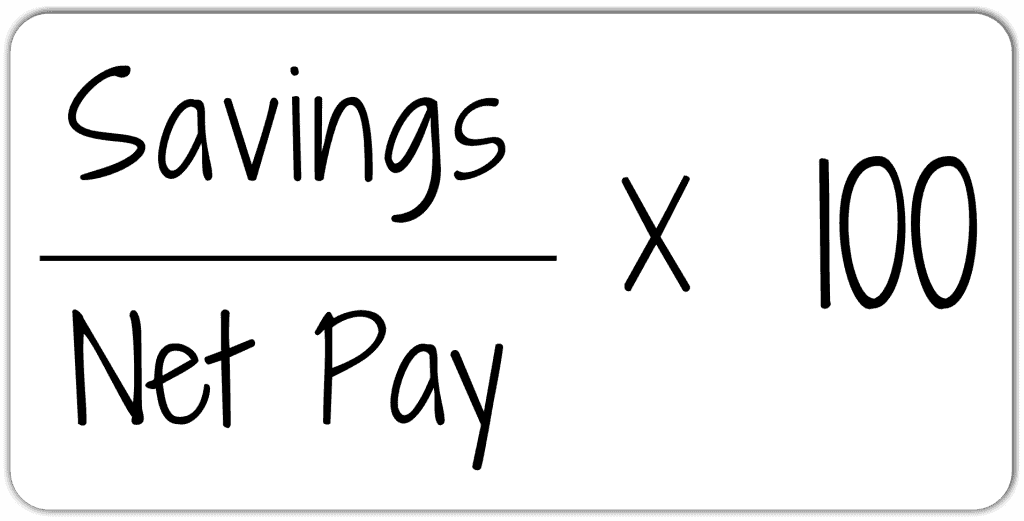
As you can see this is a very rough estimate as to your savings rate. But it is a quick back of the envelope method you can use to monitor your progress.
If you don’t like numbers or math, this simple way may be just the thing you need to stop avoiding calculating your saving rate.
The Complex Way to Calculate Saving Rate
For the complex method, you will need a few more numbers than with the simple method. Not only will you want your net pay and savings but also the amounts you and your employer contributed to your retirement accounts (employer savings and retirements savings respectively).
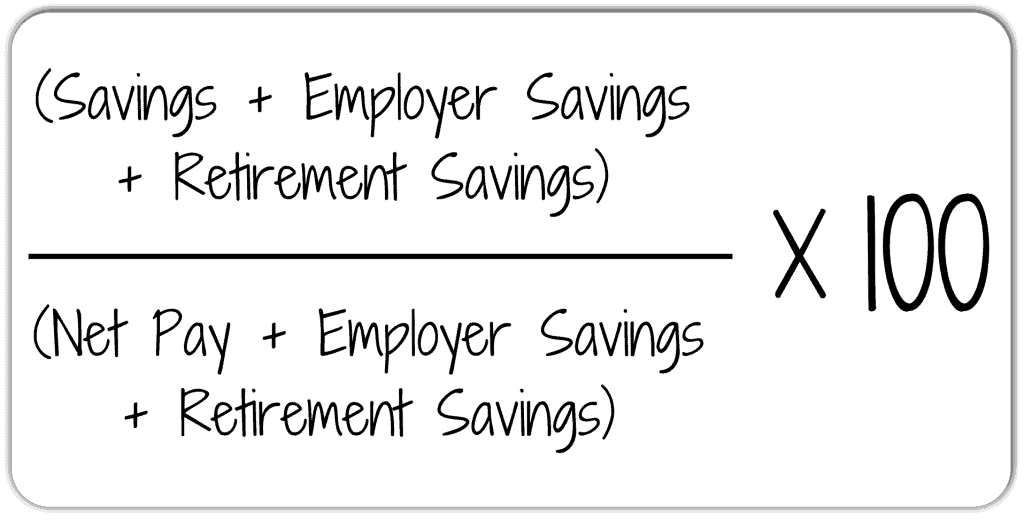
I call this the complex method because of the numbers that you need to include when calculating your saving rate. But due to the more detailed information, this method is more accurate than the simple way.
The Debt Paydown Inclusion
The debt paydown inclusion method to calculating your saving rate includes everything from the complex way but also includes any principal paydown from your debt repayment.
Principal paydown is the amount of your debt payment that goes to decreasing the actual debt amount. It does not include the interest portion.
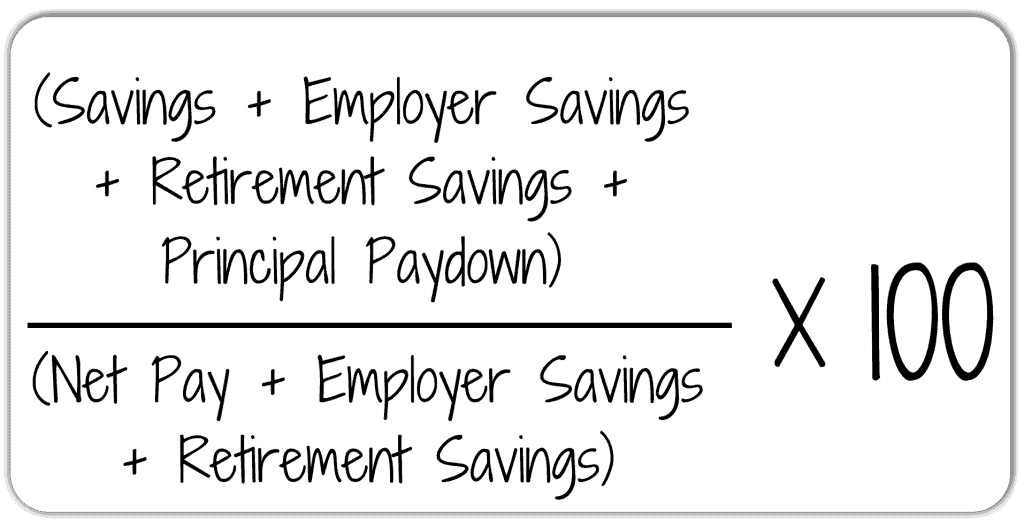
I’m not the biggest fan of this method because I think that the number is inflated. In my mind, money that goes to servicing your debt is debt repayment and not savings. But that is just my opinion.
Now that you have seen the three methods you can choose which one you decided to use. The simple way is the easiest but also gives you the lowest saving rate. If you want the glory of your highest saving rate possible then the debt paydown inclusion method is for you.
Why is Personal Saving Rate Important?
Personal saving rate is important because it can help predict how long you have to work before you can achieve financial independence. JD Roth from Get Rich Slowly states that your saving rate is the most important number in personal finance.
If you are able to save, and gradually increase your saving rate over time you can substantially decrease your timeline to financial freedom.
The added bonus of a high saving rate is when you invest that money. Now that money will have the chance to grow thanks to compound interest and your money will make you money every minute of the day. Whether you’re working or sleeping.
Mr. Money Mustache’s post the Shockingly Simple Math to Early Retirement is a classic that describes this very thing.
But if you’re like me, you need to see the numbers to have it make sense. Networthify has a great calculator that helps predict how many working years you have until retirement based on your income, saving rate, and current portfolio.
Take some time to play around with the calculator here. You are in control of the numbers you input so you can be as specific or as vague with your savings as you want with this saving rate calculator.
Here’s an example of how increasing your personal saving rate can accelerate your path to financial freedom.
Personal Saving Rate Example
I’m using conservative numbers for this example. I’m assuming a 5% annual return on investments and a 3% withdrawal rate.
You can decide what you want to include in your savings. Do you want to include your employer's contributions? Debt paydown? The use of the Networthify tool can be as simple or as complex as you want it to be.
Both Person A & B have an annual income of $60,000 and a current portfolio size of $100,000.
| Person A | Person B | |
| Expenses | $50,000 | $40,000 |
| Savings | $10,000 | $20,000 |
| Saving Rate | 16% | 34% |
| Years to FI | 38.1 | 25.1 |
Now if Person C has the same income, assumptions, and current portfolio size but is able to increase their saving rate to 50%, they only have 16.9 years to FI.
Imagine if you started with no portfolio but were able to save half of your income from the age of 20. You could comfortably become work optional at the age of 40.
Your saving rate makes a big difference doesn’t it?
What Should my Personal Saving Rate Be?
There is no one set number that your personal saving rate should be. But this is one case in which more is better.
There are some extremists in the FIRE (financial independence retire early) community who think that you must save 50%. This is just not realistic for everyone.
Increasing your income and not falling victim to lifestyle inflation will definitely make it easier to save. But saving 50% of your net take-home pay may be impossible on a lower income.
The more you are able to increase your saving rate the more options you will have. Not only will it accelerate your path to financial freedom, but it will also provide more flexibility along the way.
I am not a fan of completely depriving yourself in order to save as much as absolutely possible to sprint to financial freedom. Enjoying the journey to financial freedom is more my style currently.
But the higher your saving rate the bigger the gap between your income and expenses. This may allow you to make decisions that you wouldn’t be able to make if you have a single-digit saving rate.
I’m not here to tell you the exact number your saving rate should be. But try and increase it over time push yourself a little now; your future self will thank you.
My Household Saving Rates
When I calculated my saving rate I did it in the three ways listed above, the simple way, the complex way, and the debt paydown inclusion. It is important to note that we combine finances in our household so our numbers represent our household saving rates.
One technique we use to help us increase our saving rate is to put our money in a separate high-interest savings account. The less money we see in our chequing account, the less money we are likely to spend.
I have calculated my saving rate for 2019 and will calculate my 2020 rate at the end of the year. 2019 was a unique year in our household because there were 8 months when one of us was not working and was home on parental leave.
The Simple Way
Using rough back of the envelope math, my household saving rate for 2019 was 31.19%.
The Complex Way
When I dig down into our year-end paystubs and factor in our employer retirement contributions as well as any money we contribute to our retirement savings from our gross pay, our household saving rate for 2019 was 42.37%.
As a teacher, I have a defined benefit pension, and hubby has a defined contribution pension. So factoring in these numbers has a big impact on our saving rate.
In fact, the complex way increases our saving rate by 11.18%.
The Debt Paydown Inclusion
When it comes to personal debt, I am extremely debt-averse. That is one of the reasons why we paid down our mortgage in less than 5 years. Other than mortgage debt we never had any other debt.
I don’t consider our rental property mortgages into the equation because we run our real estate investing like a business and keep it completely separate from our personal finances; except for tax time.
But last year we turned our mortgage-free property into a rental property and moved to a new home that would better accommodate our family. That means that we now have a mortgage again (hopefully not for too long).
When we factor in mortgage principal paydown, our household saving rate for 2019 was 46.50%.
This isn’t a huge difference from the complex method; only 4.13% to be exact. The reason the mortgage paydown didn’t make a huge impact was that we only had a mortgage for less than half of the year because of the timing of our move.
Final Thoughts
Your saving rate is a number. You get to decide what emotions you attach to that number. Personally, I attach very few emotions to our household saving rate. We do try and gamifying it a bit by trying to increase it over time. This is something I would highly recommend.
But the next time you hear someone brag about how much of their income they save, take it with a grain of salt.
You now know that there are many different ways of calculating your saving rate. And the method you choose to use will greatly affect the overall number.
Keep your personal saving rate personal and instead of comparing it to others stay consistent in how you calculate it. This will enable you to monitor your progress in increasing the number over time.